# Protocols
# Confined Space Initial Evaluation
[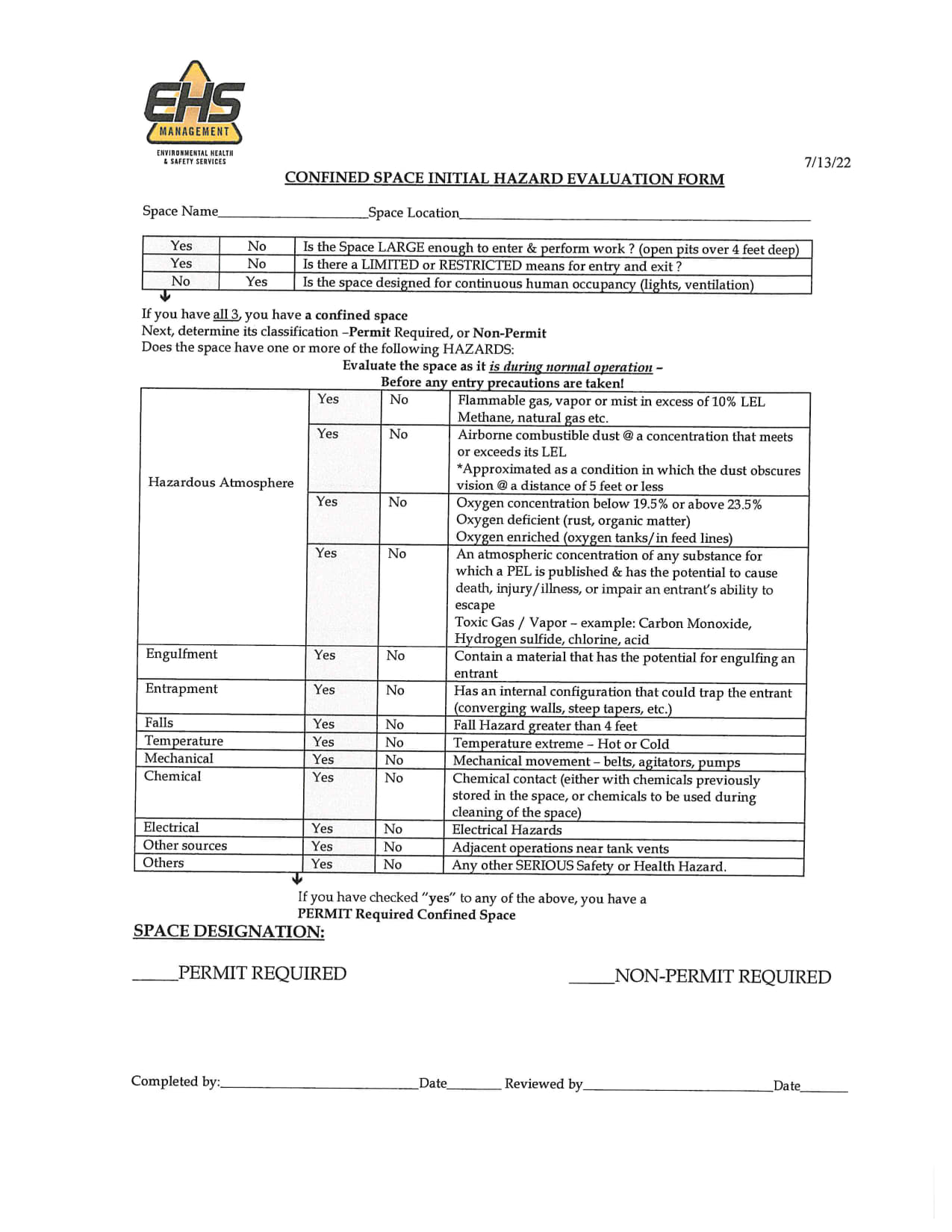](https://safety.scswiderski.net/uploads/images/gallery/2024-04/confined-space-evaluation.jpg)
# Confined Space Checklist
[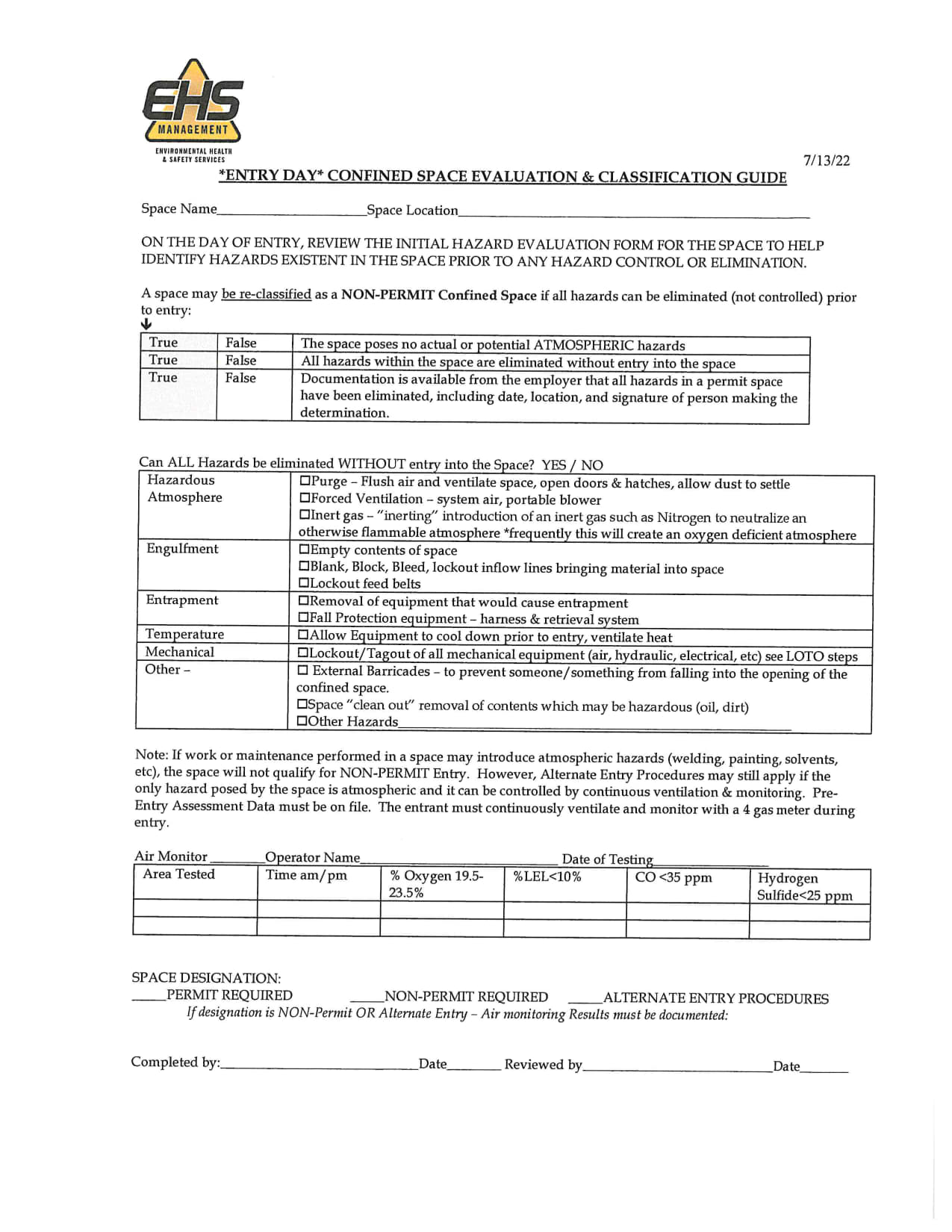](https://safety.scswiderski.net/uploads/images/gallery/2024-04/confined-space-checklist.jpg)
# Confined Space SOP
**CONFINED SPACE PROGRAM**
**1. General**: This program establishes requirements for practices and procedures to protect employees in general industry from the hazards of entry into permit-required confined spaces.
2. **Responsibility:** SCS Safety and Compliance Manager shall have the responsibility of managing this program.
3. **Definitions:**
*Acceptable entry conditions* mean the conditions that must exist in a permit space to allow entry and to ensure that employees involved with a permit-required confined space entry can safely enter into and work within the space.
*Attendant* means an individual stationed outside one or more permit spaces who monitors the authorized entrants and who performs all attendant's duties assigned in the employer's permit space program.
*Authorized entrant* means an employee who is authorized by the employer to enter a permit space.
*Blanking or blinding* means the absolute closure of a pipe, line, or duct by the fastening of a solid plate (such as a spectacle blind or a skillet blind) that completely covers the bore and that is capable of withstanding the maximum pressure of the pipe, line, or duct with no leakage beyond the plate.
*Confined space* means a space that:
(1) Is large enough and so configured that an employee can bodily enter and perform assigned work; and
(2) Has limited or restricted means for entry or exit (for example, tanks, vessels, silos, storage bins, hoppers, vaults, and pits are spaces that may have limited means of entry.); and
(3) Is not designed for continuous employee occupancy.
*Double block and bleed* means the closure of a line, duct, or pipe by closing and locking or tagging two in-line valves and by opening and locking or tagging a drain or vent valve in the line between the two closed valves.
*Emergency* means any occurrence (including any failure of hazard control or monitoring equipment) or event internal or external to the permit space that could endanger entrants.
*Engulfment* means the surrounding and effective capture of a person by a liquid or finely divided (flowable) solid substance that can be aspirated to cause death by filling or plugging the respiratory system or that can exert enough force on the body to cause death by strangulation, constriction, or crushing.
*Entry* means the action by which a person passes through an opening into a permit-required confined space. Entry includes ensuing work activities in that space and is considered to have occurred as soon as any part of the entrant's body breaks the plane of an opening into the space.
*Entry permit* (permit) means the written or printed document that is provided by the employer to allow and control entry into a permit space and that contains the information specified in paragraph (f) of this section.
*Entry supervisor* means the person (such as the employer, foreman, or crew chief) responsible for determining if acceptable entry conditions are present at a permit space where entry is planned, for authorizing entry and overseeing entry operations, and for terminating entry as required by this section.
Note: An entry supervisor also may serve as an attendant or as an authorized entrant, as long as that person is trained and equipped as required by this section for each role he or she fills. Also, the duties of entry supervisor may be passed from one individual to another during the course of an entry operation.
*Hazardous atmosphere* means an atmosphere that may expose employees to the risk of death, incapacitation, impairment of ability to self-rescue (that is, escape unaided from a permit space), injury, or acute illness from one or more of the following causes:
(1) Flammable gas, vapor, or mist in excess of 10 percent of its lower flammable limit (LFL);
(2) Airborne combustible dust at a concentration that meets or exceeds its LFL;
Note: This concentration may be approximated as a condition in which the dust obscures vision at a distance of 5 feet (1.52 m) or less.
(3) Atmospheric oxygen concentration below 19.5 percent or above 23.5 percent;
(4) Atmospheric concentration of any substance for which a dose or a permissible exposure limit is published in subpart G, Occupational Health and Environmental Control, or in subpart Z, Toxic and Hazardous Substances, of this part and which could result in employee exposure in excess of its dose or permissible exposure limit;
Note: An atmospheric concentration of any substance that is not capable of causing death, incapacitation, impairment of ability to self-rescue, injury, or acute illness due to its health effects is not covered by this provision.
(5) Any other atmospheric condition that is immediately dangerous to life or health.
Note: For air contaminants for which OSHA has not determined a dose or permissible exposure limit, other sources of information, such as Material Safety Data Sheets that comply with the Hazard Communication Standard, § 1910.1200 of this part, published information, and internal documents can provide guidance in establishing acceptable atmospheric conditions.
*Hot work permit* means the employer's written authorization to perform operations (for example, riveting, welding, cutting, burning, and heating) capable of providing a source of ignition.
*Immediately dangerous to life or health (IDLH)* means any condition that poses an immediate or delayed threat to life or that would cause irreversible adverse health effects or that would interfere with an individual's ability to escape unaided from a permit space.
*Inerting* means the displacement of the atmosphere in a permit space by a noncombustible gas (such as nitrogen) to such an extent that the resulting atmosphere is noncombustible.
Note: This procedure produces an IDLH oxygen-deficient atmosphere.
*Isolation* means the process by which a permit space is removed from service and completely protected against the release of energy and material into the space by such means as: blanking or blinding; misaligning or removing sections of lines, pipes, or ducts; a double block and bleed system; lockout or tagout of all sources of energy; or blocking or disconnecting all mechanical linkages.
*Line breaking* means the intentional opening of a pipe, line, or duct that is or has been carrying flammable, corrosive, or toxic material, an inert gas, or any fluid at a volume, pressure, or temperature capable of causing injury.
*Non-permit confined space* means a confined space that does not contain or, with respect to atmospheric hazards, have the potential to contain any hazard capable of causing death or serious physical harm.
*Oxygen deficient atmosphere* means an atmosphere containing less than 19.5 percent oxygen by volume.
*Oxygen enriched atmosphere* means an atmosphere containing more than 23.5 percent oxygen by volume.
*Permit-required confined space* (permit space) means a confined space that has one or more of the following characteristics:
(1) Contains or has a potential to contain a hazardous atmosphere;
(2) Contains a material that has the potential for engulfing an entrant;
(3) Has an internal configuration such that an entrant could be trapped or asphyxiated by inwardly converging walls or by a floor which slopes downward and tapers to a smaller cross-section; or
(4) Contains any other recognized serious safety or health hazard.
*Permit-required confined space program* (permit space program) means the employer's overall program for controlling, and, where appropriate, for protecting employees from, permit space hazards and for regulating employee entry into permit spaces.
*Permit system* means the employer's written procedure for preparing and issuing permits for entry and for returning the permit space to service following termination of entry.
*Prohibited condition* means any condition in a permit space that is not allowed by the permit during the period when entry is authorized.
*Rescue service* means the personnel designated to rescue employees from permit spaces.
*Retrieval system* means the equipment (including a retrieval line, chest or full-body harness, wristlets, if appropriate, and a lifting device or anchor) used for non-entry rescue of persons from permit spaces.
*Testing* means the process by which the hazards that may confront entrants of a permit space are identified and evaluated. Testing includes specifying the tests that are to be performed in the permit space.
Note: Testing enables employers both to devise and implement adequate control measures for the protection of authorized entrants and to determine if acceptable entry conditions are present immediately prior to, and during, entry.
**4.0. General Requirements:**
4.1. The employer shall evaluate the workplace to determine if any spaces are permit-required confined spaces.
Note: Proper application of the decision flow chart in appendix A to § 1910.146 would facilitate compliance with this requirement.
4.2. If the workplace contains permit spaces, the employer shall inform exposed employees, by posting danger signs or by any other equally effective means, of the existence and location of and the danger posed by the permit spaces.
Note: A sign reading "DANGER - PERMIT-REQUIRED CONFINED SPACE, DO NOT ENTER" or using other similar language would satisfy the requirement for a sign.
4.3. If the employer decides that its employees will not enter permit spaces, the employer shall take effective measures to prevent its employees from entering the permit spaces.
4.4. If the employer decides that its employees will enter permit spaces, the employer shall develop and implement a written permit space program that complies with this section. The written program shall be available for inspection by employees and their authorized representatives.
4.5. The employer shall demonstrate that the only hazard posed by the permit space is an actual or potentially hazardous atmosphere.
4.6. The employer can demonstrate that continuous forced air ventilation alone is sufficient to maintain that permit space safe for entry.
4.7. The employer develops monitoring and inspection data.
4.8. Any conditions making it unsafe to remove an entrance cover shall be eliminated before the cover is removed.
4.9. When entrance covers are removed, the opening shall be promptly guarded by a railing, temporary cover, or other temporary barriers that will prevent an accidental fall through the opening and that will protect each employee working in the space from foreign objects entering the space.
4.10. Before an employee enters the space, the internal atmosphere shall be tested, with a calibrated direct-reading instrument, for oxygen content, for flammable gases and vapors, and for potential toxic air contaminants, in that order. Any employee who enters the space, or that employee's authorized representative, shall be provided an opportunity to observe the pre-entry testing required by this paragraph.
4.11. There may be no hazardous atmosphere within the space whenever any employee is inside the space.
4.12. Continuous forced air ventilation shall be used.
4.13. An employee may not enter the space until the forced air ventilation has eliminated any hazardous atmosphere.
4.14. The forced air ventilation shall be so directed as to ventilate the immediate areas where an employee is or will be present within the space and shall continue until all employees have left the space.
4.15. The air supply for the forced air ventilation shall be from a clean source and may not increase the hazards in the space.
4.16. The atmosphere within the space shall be periodically tested as necessary to ensure that the continuous forced air ventilation is preventing the accumulation of a hazardous atmosphere. Any employee who enters the space, or that employee's authorized representative, shall be provided with an opportunity to observe the periodic testing required by this paragraph.
4.17. If a hazardous atmosphere is detected during entry, each employee shall leave the space immediately.
4.18. The space shall be evaluated to determine how the hazardous atmosphere developed; and measures shall be implemented to protect employees from the hazardous atmosphere before any subsequent entry takes place.
4.19. The employer shall verify that the space is safe for entry and that the pre-entry measures required have been taken, through a written certification that contains the date, the location of the space, and the signature of the person providing the certification. The certification shall be made before entry and shall be made available to each employee entering the space or to that employee's authorized representative.
4.20. When there are changes in the use or configuration of a non-permit confined space that might increase the hazards to entrants, the employer shall reevaluate that space and, if necessary, reclassify it as a permit-required confined space.
4.20. A space classified by the employer as a permit-required confined space may be reclassified as a non-permit confined space under the following procedures:
4.20.1. If the permit space poses no actual or potential atmospheric hazards and if all hazards within the space are eliminated without entry into the space, the permit space may be reclassified as a non-permit confined space for as long as the non-atmospheric hazards remain eliminated.
4.20.2. If testing and inspection during that entry demonstrate that the hazards within the permit space have been eliminated, the permit space may be reclassified as a non-permit confined space for as long as the hazards remain eliminated.
Note: Control of atmospheric hazards through forced air ventilation does not constitute elimination of the hazards.
4.21. The employer shall document the basis for determining that all hazards in a permit space have been eliminated, through a certification that contains the date, the location of the space, and the signature of the person making the determination. The certification shall be made available to each employee entering the space or to that employee's authorized representative. If hazards arise within a permit space that has been declassified to a non-permit space under, each employee in the space shall exit the space. The employer shall then re-evaluate the space and determine whether it must be reclassified as a permit space, in accordance with other applicable provisions of this section.
4.22. When an employer (host employer) arranges to have employees of another employer (contractor) perform work that involves permit space entry, the host employer shall:
4.22.1. Inform the contractor that the workplace contains permit spaces and that permit space entry is allowed only through compliance with a permit space program meeting the requirements of this section.
4.22.2. Apprise the contractor of the elements, including the hazards identified and the host employer's experience with the space, that make the space in question a permit space.
4.22.3. Apprise the contractor of any precautions or procedures that the host employer has implemented for the protection of employees in or near permit spaces where contractor personnel will be working.
4.22.4. Coordinate entry operations with the contractor, when both host employer personnel and contractor personnel will be working in or near permit spaces, as required by paragraph (d)(11) of this section; and
4.22.5. Debrief the contractor at the conclusion of the entry operations regarding the permit space program followed and regarding any hazards confronted or created in permit spaces during entry operations.
4.23. In addition to complying with the permit space requirements that apply to all employers, each contractor who is retained to perform permit space entry operations shall:
4.23.1. Obtain any available information regarding permit space hazards and entry operations from the host employer.
4.23.2. Coordinate entry operations with the host employer, when both host employer personnel and contractor personnel will be working in or near permit spaces, as required by paragraph (d)(11) of this section; and
4.23.3. Inform the host employer of the permit space program that the contractor will follow and of any hazards confronted or created in permit spaces, either through a debriefing or during the entry operation.
*** ***
**5.0. Permit-required confined space program** (permit space program). Under the permit space program, the employer shall:
5.1. Implement the necessary measures to prevent unauthorized entry.
5.2. Identify and evaluate the hazards of permit spaces before employees enter them.
5.3. Develop and implement the means, procedures, and practices necessary for safe permit space entry operations, including, but not limited to, the following:
5.3.1. Specifying acceptable entry conditions.
5.3.2. Providing each authorized entrant or that employee's authorized representative with the opportunity to observe any monitoring or testing of permit spaces.
5.3.3. Isolating the permit space.
5.3.4. Purging, inerting, flushing, or ventilating the permit space as necessary to eliminate or control atmospheric hazards.
5.3.5. Providing pedestrians, vehicle, or other barriers as necessary to protect entrants from external hazards; and
5.3.6. Verifying that conditions in the permit space are acceptable for entry throughout the duration of an authorized entry.
5.3.7. Provide equipment at no cost to employees, maintain that equipment properly, and ensure that employees use that equipment properly:
5.3.8. Provide testing and monitoring equipment needed to support operations.
5.3.9. Ventilating equipment is required to obtain acceptable entry conditions.
5.3.10. Communications equipment necessary to support operations.
5.3.11. Personal protective equipment insofar as feasible engineering and work practice controls do not adequately protect employees.
5.3.12. Lighting equipment is needed to enable employees to see well enough to work safely and to exit the space quickly in an emergency.
5.3.13. Barriers, shields, and equipment, such as ladders, needed for safe ingress and egress by authorized entrants.
5.3.14. Rescue and emergency equipment needed except to the extent that the equipment is provided by rescue services; and
5.3.15. Any other equipment necessary for safe entry into and rescue from permit spaces.
5.4. Evaluate permit space conditions as follows when entry operations are conducted:
5.4.1. Test conditions in the permit space to determine if acceptable entry conditions exist before entry is authorized to begin, except that, if isolation of the space is infeasible because the space is large or is part of a continuous system (such as a sewer), pre-entry testing shall be performed to the extent feasible before entry is authorized and, if entry is authorized, entry conditions shall be continuously monitored in the areas where authorized entrants are working;
5.4.2. Test or monitor the permit space as necessary to determine if acceptable entry conditions are being maintained during entry operations; and
5.4.3. When testing for atmospheric hazards, test first for oxygen, then for combustible gases and vapors, and then for toxic gases and vapors.
5.4.4. Provide each authorized entrant or that employee's authorized representative an opportunity to observe the pre-entry and any subsequent testing or monitoring of permit spaces.
5.4.5. Reevaluate the permit space in the presence of any authorized entrant or that employee's authorized representative who requests that the employer conduct such reevaluation because the entrant or representative has reason to believe that the evaluation of that space may not have been adequate.
5.4.6. Immediately provide each authorized entrant or that employee's authorized representative with the results of any testing conducted.
5.5. Provide at least one attendant outside the permit space into which entry is authorized for the duration of entry operations;
Note: Attendants may be assigned to monitor more than one permit space provided the duties can be effectively performed for each permit space that is monitored. Likewise, attendants may be stationed at any location outside the permit space to be monitored if they can be effectively performed for each permit space that is monitored.
5.6. If multiple spaces are to be monitored by a single attendant, include in the permit program the means and procedures to enable the attendant to respond to an emergency affecting one or more of the permit spaces being monitored without distraction from the attendant's responsibilities.
5.7. Designate the people who are to have active roles (as, for example, authorized entrants, attendants, entry supervisors, or individuals who test or monitor the atmosphere in a permit space) in entry operations, identify the duties of each such employee, and provide each such employee with the required training.
5.8. Develop and implement procedures for summoning rescue and emergency services, for rescuing entrants from permit spaces, for providing necessary emergency services to rescued employees, and for preventing unauthorized personnel from attempting a rescue.
5.9. Develop and implement a system for the preparation, issuance, use, and cancellation of entry permits as required by this section.
5.10. Develop and implement procedures to coordinate entry operations when employees of more than one employer are working simultaneously as authorized entrants in a permit space, so that employees of one employer do not endanger the employees of any other employer.
5.11. Develop and implement procedures (such as closing off a permit space and canceling the permit) necessary for concluding the entry after operations have been completed.
5.12. Review entry operations when the employer has reason to believe that the measures taken under the permit space program may not protect employees and revise the program to correct deficiencies found to exist before subsequent entries are authorized; and
Note: Examples of circumstances requiring the review of the permit space program are: any unauthorized entry of a permit space, the detection of a permit space hazard not covered by the permit, the detection of a condition prohibited by the permit, the occurrence of an injury or near-miss during entry, a change in the use or configuration of a permit space, and employee complaints about the effectiveness of the program.
5.13. Review the permit space program, using the canceled permits retained within 1 year after each entry and revise the program as necessary, to ensure that employees participating in entry operations are protected from permit space hazards.
Note: Employers may perform a single annual review covering all entries performed during a 12-month period. If no entry is performed during a 12-month period, no review is necessary.
**6.0. Permit system.**
6.1. Before entry is authorized, the employer shall document the completion of measures required by preparing an entry permit.
6.2. Before entry begins, the entry supervisor identified on the permit shall sign the entry permit to authorize entry.
6.3. The completed permit shall be made available at the time of entry to all authorized entrants or their authorized representatives, by posting it on the entry portal or by any other equally effective means, so that the entrants can confirm that pre-entry preparations have been completed.
6.4. The duration of the permit may not exceed the time required to complete the assigned task or job identified on the permit.
6.5. The entry supervisor shall terminate entry and cancel the entry permit when:
6.5.1. The entry operations covered by the entry permit have been completed; or
6.5.2. A condition that is not allowed under the entry permit arises in or near the permit space.
6.6. The employer shall retain each canceled entry permit for at least 1 year to facilitate the review of the permit-required confined space program. Any problems encountered during an entry operation shall be noted on the pertinent permit so that appropriate revisions to the permit space program can be made.
*** ***
**7.0. Entry permit.**
7.1. The entry permit documents compliance with this section and authorizes entry to a permit space shall identify:
A. The permit space that is to be entered.
B. The purpose of the entry.
C. The date and the authorized duration of the entry permit.
D. The authorized entrants within the permit space, by name or by such other means (for example, using rosters or tracking systems) as will enable the attendant to determine quickly and accurately, for the duration of the permit, which authorized entrants are inside the permit space.
Note: This requirement may be met by inserting a reference on the entry permit as to the means used, such as a roster or tracking system, to keep track of the authorized entrants within the permit space.
E. The personnel, by name, serving as attendants.
F. The individual, by name, serving as entry supervisor, with a space for the signature or initials of the entry supervisor who originally authorized entry.
G. The hazards of the permit space to be entered.
H. The measures used to isolate the permit space and to eliminate or control permit space hazards before entry;
Note: Those measures can include the lockout or tagging of equipment and procedures for purging, inerting, ventilating, and flushing permit spaces.
I. The acceptable entry conditions.
J. The results of initial and periodic tests performed under paragraph (d)(5) of this section, accompanied by the names or initials of the testers and by an indication of when the tests were performed.
K. The rescue and emergency services that can be summoned and the means (such as the equipment to use and the numbers to call) for summoning those services.
L. The communication procedures used by authorized entrants and attendants to maintain contact during entry.
M. Equipment, such as personal protective equipment, testing equipment, communications equipment, alarm systems, and rescue equipment, to be provided for compliance with this section.
N. Any other information whose inclusion is necessary, given the circumstances of the confined space, to ensure employee safety; and
O. Any additional permits, such as for hot work, that have been issued to authorize work in the permit space.
**8.0. Training.**
8.1. The employer shall provide training so that all employees whose work is regulated by this section acquire the understanding, knowledge, and skills necessary for the safe performance of the duties assigned under this section.
8.2. Training shall be provided for each affected employee:
8.2.1. Before the employee is first assigned duties under this section.
8.2.2. Before there is a change in assigned duties.
8.2.3. Whenever there is a change in permit space operations that presents a hazard about which an employee has not previously been trained.
8.2.4. Whenever the employer has reason to believe either that there are deviations from the permit space entry procedures or that there are inadequacies in the employee's knowledge or use of these procedures.
8.2.5. The training shall establish employee proficiency in the duties required by this section and shall introduce new or revised procedures, as necessary, for compliance with this section.
8.2.6. The employer shall certify that the training required has been accomplished. The certification shall contain each employee's name, the signatures or initials of the trainers, and the dates of training. The certification shall be available for inspection by employees and their authorized representatives.
*** ***
**9.0. Duties of authorized entrants**.
9.1. The employer shall ensure that all authorized entrants:
A. Know the hazards that may be faced during entry, including information on the mode, signs or symptoms, and consequences of the exposure.
B. Properly use equipment.
C. Communicate with the attendant as necessary to enable the attendant to monitor entrant status and alert entrants of the need to evacuate the space.
9.2. Alert the attendant whenever:
A. The entrant recognizes any warning sign or symptom of exposure to a dangerous situation, or
B. The entrant detects a prohibited condition; and
C. Exit from the permit space as quickly as possible whenever:
D. An order to evacuate is given by the attendant or the entry supervisor,
E. The entrant recognizes any warning sign or symptom of exposure to a dangerous situation,
F. The entrant detects a prohibited condition, or
G. An evacuation alarm is activated.
**10.0. Duties of attendants**. The employer shall ensure that each attendant:
10.1. Knows the hazards that may be faced during entry, including information on the mode, signs or symptoms, and consequences of the exposure.
10.2. Is aware of possible behavioral effects of hazard exposure in authorized entrants.
10.3. Continuously maintains an accurate count of authorized entrants in the permit space and ensures that the means used to identify authorized entrants accurately identifies who is in the permit space.
10.4. Remains outside the permit space during entry operations until relieved by another attendant.
Note: When the employer's permit entry program allows attendant entry for rescue, attendants may enter a permit space to attempt a rescue if they have been trained and equipped for rescue operations.
10.5. Communicates with authorized entrants as necessary to monitor entrant status and to alert entrants of the need to evacuate the space.
10.6. Monitors activities inside and outside the space to determine if it is safe for entrants to remain in the space and orders the authorized entrants to evacuate the permit space immediately under any of the following conditions.
10.6.1. If the attendant detects a prohibited condition.
10.6.2. If the attendant detects the behavioral effects of hazard exposure in an authorized entrant.
10.6.3. If the attendant detects a situation outside the space that could endanger the authorized entrants; or
10.6.4. If the attendant cannot effectively and safely perform all the duties required.
10.6.5. Summon rescue and other emergency services as soon as the attendant determines that authorized entrants may need assistance to escape from permit space hazards.
10.7. Takes the following actions when unauthorized persons approach or enter a permit space while entry is underway:
10.7.1. Warn the unauthorized persons that they must stay away from the permit space.
10.7.2. Advise the unauthorized persons that they must exit immediately if they have entered the permit space; and
10.7.3. Inform the authorized entrants and the entry supervisor if unauthorized persons have entered the permit space.
10.7.4. Performs non-entry rescues as specified by the employer's rescue procedure; and
10.7.5. Performs no duties that might interfere with the attendant's primary duty to monitor and protect the authorized entrants.
** **
**11.0. Duties of entry supervisors**.
11.1. The employer shall ensure that each entry supervisor:
11.1.1. Knows the hazards that may be faced during entry, including information on the mode, signs or symptoms, and consequences of the exposure.
11.1.2. Verifies, by checking that the appropriate entries have been made on the permit, that all tests specified by the permit have been conducted and that all procedures and equipment specified by the permit are in place before endorsing the permit and allowing entry to begin.
11.1.3. Terminates the entry and cancels the permit if necessary.
11.1.4. Verifies that rescue services are available and that the means for summoning them are operable.
11.1.5. Removes unauthorized individuals who enter or who attempt to enter the permit space during entry operations; and
11.1.6. Determines, whenever responsibility for a permit space entry operation is transferred and at intervals dictated by the hazards and operations performed within the space, that entry operations remain consistent with terms of the entry permit and that acceptable entry conditions are maintained.
*** ***
**12.0. Rescue and emergency services.**
12.1. An employer who designates rescue and emergency services shall:
12.1.1. Evaluate a prospective rescuer's ability to respond to a rescue summons in a timely manner, considering the hazard(s) identified.
12.1.2. Evaluate a prospective rescue service's ability, in terms of proficiency with rescue-related tasks and equipment, to function appropriately while rescuing entrants from the permit space or types of permit spaces identified.
12.2. Select a rescue team or service from those evaluated that:
12.2.1. Has the capability to reach the victim(s) within a time frame that is appropriate for the permit space hazard(s) identified.
12.2.2. Is equipped for and proficient in performing the needed rescue services.
12.2.3. Inform each rescue team or service of the hazards they may confront when called on to perform rescue at the site; and
12.2.4. Provide the rescue team or service selected with access to all permit spaces from which rescue may be necessary so that the rescue service can develop appropriate rescue plans and practice rescue operations.
12.3. An employer whose employees have been designated to provide permit space rescue and emergency services shall take the following measures:
12.3.1. Provide affected employees with the personal protective equipment (PPE) needed to conduct permit space rescues safely and train affected employees, so they are proficient in the use of that PPE, at no cost to those employees.
12.3.2. Train affected employees to perform assigned rescue duties. The employer must ensure that such employees successfully complete the training required to establish proficiency as an authorized entrant.
12.3.3. Train affected employees in basic first aid and cardiopulmonary resuscitation (CPR). The employer shall ensure that at least one member of the rescue team or service holding a current certification in first aid and CPR is available: and
12.3.4. Ensure that affected employees practice making permit space rescues at least once every 12 months, by means of simulated rescue operations in which they remove dummies, manikins, or actual persons from the actual permit spaces or from representative permit spaces. Representative permit spaces shall, with respect to opening size, configuration, and accessibility, simulate the types of permit spaces from which rescue is to be performed.
12.4. To facilitate non-entry rescue, retrieval systems or methods shall be used whenever an authorized entrant enters a permit space, unless the retrieval equipment would increase the overall risk of entry or would not contribute to the rescue of the entrant. Retrieval systems shall meet the following requirements.
12.5. Each authorized entrant shall use a chest or full body harness, with a retrieval line attached at the center of the entrant's back near shoulder level, above the entrant's head, or at another point which the employer can establish presents a profile small enough for the successful removal of the entrant. Wristlets may be used in lieu of the chest or full body harness if the employer can demonstrate that the use of a chest or full body harness is infeasible or creates a greater hazard and that the use of wristlets is the safest and most effective alternative.
12.6. The other end of the retrieval line shall be attached to a mechanical device or fixed point outside the permit space in such a manner that rescue can begin as soon as the rescuer becomes aware that rescue is necessary. A mechanical device shall be available to retrieve personnel from vertical type permit spaces more than 5 feet (1.52 m) deep.
12.7. If an injured entrant is exposed to a substance for which a Safety Data Sheet (SDS) or other similar written information is required to be kept at the worksite, that SDS or written information shall be made available to the medical facility treating the exposed entrant.
**13.0. Employee participation.**
13.1. Employers shall consult with affected employees and their authorized representatives on the development and implementation of all aspects of the permit space program.
13.2. Employers shall make available to affected employees and their authorized representatives all the information required to be developed by this se