# July 2025
# TBT 07-09-2025 Power Tools and Equipment - Mounting Abrasive Wheels
**OSHA Training Toolbox Talk: Portable Tool and Equipment Safety – Mounting Abrasive Wheels** \[Reference 1910.243 / 1926.303\]
Portable hand-held grinders are relatively small tools, but they can pack a lot of punch - especially if the abrasive wheel shatters when the grinder is running! But many common accidents can be avoided by following these steps when installing an abrasive wheel onto a portable grinder.
First, check the label on the abrasive wheel to make certain it is intended to be used on the type of material you will be using it on. There are some general-purpose wheels, but many are intended to be used only on specific types of materials, such as specific metals (like aluminum or carbon steel), masonry, or concrete. Also be aware that some abrasive wheels are designed only for grinding, while others are designed to be used for cutting. So only use the abrasive wheel for the purpose and material for which it is intended, or it could break or shatter.
Then check the diameter of the abrasive wheel, as well as its maximum rated speed, to make sure it is suitable for use with your grinder. The speed ratings for an abrasive wheel and for your grinder are usually expressed in revolutions per minute, or RPM’s. Placing an under-rated abrasive wheel on a grinder that turns faster than the rated speed of that wheel can cause it to break apart and send small pieces of the wheel flying! Also, make sure the arbor size (center hole) of your abrasive wheel is the right size for your grinder. If the arbor hole is too small and you must force it onto the grinder, the wheel could crack. And if the arbor hole is too large, the wheel could become unbalanced when you turn on your grinder and then break apart.
Next, check the wheel to see if it has any visible damage or breaks. You should also check for hidden cracks by “sounding” the abrasive wheel; this is also called a “ring test”. Balance the abrasive wheel on your finger, or even better, on a metal object such as the shaft of a screwdriver. Then strike the abrasive wheel with the wooden handle of a screwdriver on one side and listen for a “ringing” noise; this indicates that portion of the wheel is not cracked. But if you hear a dead “thud” sound, this means the wheel could be cracked and shouldn’t be used. Repeat this test by rotating the wheel a quarter turn and then sounding all areas of the wheel.
Finally, take care not to over-tighten the retaining ring that holds the abrasive wheel onto the grinder, as applying too much torque can cause the wheel to crack. And of course, also make certain the guard has been properly reinstalled on your grinder. And when you first use a portable hand-held grinder with a new wheel installed, always position the grinder so that if you turn it on and the wheel happens to break, the particles will be deflected away from you.
# TBT 07-14-2025 Competent Person - Excavation Site
SCS Toolbox Talk: **The Role of the Competent Person on an Excavation Site-**\[Reference 1926 Subpart P\]
Every action you take on an excavation site could have negative impacts on the safety of yourself or others. Digging in an area without first locating underground utilities could cause serious disruption of service, and maybe even an electrocution or explosion. Entering a trench that does not have a properly constructed protective system could result in you being caught in a sudden cave-in. And entering an excavation containing a hazardous atmosphere could prove to be deadly as well. Because of these and other hazards associated with excavation work, the Occupational Safety and Health Administration, also called OSHA, requires organizations like ours to designate someone at the excavation site to be responsible for performing critical functions to ensure the safety of our workers. And that person is known as the “**Competent Person**”.
Here is an overview of just a few of the major duties performed by the Competent Person at an excavation site:
**The Competent Person** analyzes the soil and other conditions at the excavation site to determine whether we must utilize some form of protective system, such as sloping, shoring, or a trench box, to prevent workers from being caught in a cave-in when we are working inside certain excavations.
**The Competent Person** determines that any protective system we do utilize is adequate in terms of strength and suitability for the excavation where it is being utilized, and that it is properly installed, moved, and removed throughout the course of the job.
**The Competent Person** also conducts regular inspections of the excavation sites, protective systems, and equipment in use to identify any hazards that may develop while we are working on an excavation. This may even include evaluating certain excavations for the presence of a potentially hazardous atmosphere or evaluating whether unexpected events like a heavy rainstorm or a broken water pipe have created a hazardous condition that must be addressed before we resume work.
**The Competent Person** has the authority from his or her employer to remove workers from areas whenever any hazardous situation arises until the hazard has been corrected or removed.
However, the Competent Person cannot always be everywhere on the jobsite, nor can they see everything that is going on. When you do see a potential problem, be sure to take steps to ensure the safety of yourself and others and then inform the Competent Person or your supervisor of what you’ve seen.
# 7-21-2025 TBT Warning/Safety Lines
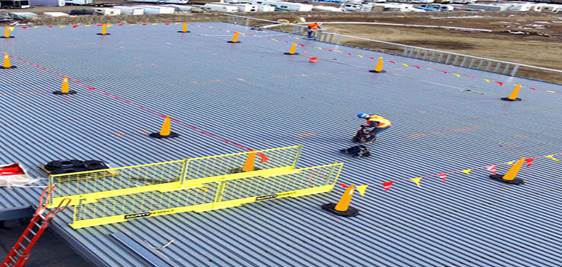
ToolBox Talk -07-21-2025 – **Warning/Safety Lines on Structures **
[Fall protection warning lines are critical safety measures used in construction to prevent falls. According to OSHA regulations, warning lines must be erected around all sides of the roof work area, or unprotected edge typically at least 6 feet from the roof/wall edge when mechanical equipment is not in use. These lines serve as a visual barrier to alert workers of the unprotected edges and are essential in fall protection plans, especially on low slope roofs. It's important to note that while warning lines are a key component of fall protection, they should be used in conjunction with other safety measures, such as guardrails, to ensure comprehensive safety. ](https://www.bing.com/ck/a?!&&p=43374fcc8681d11e72b5bdb454712924085afea4201a6bd379088104a71000b1JmltdHM9MTc1MzA1NjAwMA&ptn=3&ver=2&hsh=4&fclid=02604922-c84b-670a-18ed-5cebc935665c&psq=warning+lines+fall+protection&u=a1aHR0cHM6Ly93d3cub3NoYS5nb3YvbGF3cy1yZWdzL3JlZ3VsYXRpb25zL3N0YW5kYXJkbnVtYmVyLzE5MjYvMTkyNi41MDI&ntb=1)
[](file:///C:/Users/Blain.Schumacher/Desktop)
# TBT - 7/28/2025 Heat Illness
Several conditions, collectively known as heat illnesses, are caused by or related to an excessive core body temperature, which occurs when the body is unable to cool itself effectively. These ailments range from mild to life-threatening, and it’s essential to recognize the signs early to prevent serious damage. The symptoms of the primary types of heat illnesses, ranked from least to most serious, include:
\- Heat Rash, which appears as a skin irritation caused by blocked sweat glands. This leads to red, itchy bumps, often in areas where sweat accumulates. Though uncomfortable, it’s generally not severe, but it can be a sign that the body is struggling to cool down.
\- Heat Cramps, which are painful muscle spasms caused by excessive electrolyte loss through sweating. Electrolytes—such as sodium, potassium, and magnesium—are vital for fluid balance, muscle function, and proper nerve function. When these electrolytes are depleted, muscles can cramp and cause significant discomfort.
\- Heat Syncope, (pronounced sin-kuh-pee) is caused by dehydration and reduced blood flow to the brain. It often results from prolonged standing in the heat or sudden posture changes. Symptoms include dizziness, lightheadedness, and even temporary loss of consciousness.
\- Heat Exhaustion, which is a more serious condition marked by heavy sweating, dizziness, fatigue, nausea, and an elevated core body temperature. Without prompt intervention—such as rehydration and cooling down—heat exhaustion can escalate quickly to heat stroke, a much more dangerous condition.
\- Heat Stroke, the most severe form of heat illness is heat stroke, a life-threatening emergency where the body’s internal core temperature, which is usually around 98.7 degrees Fahrenheit, exceeds 104 degrees. A key sign of heat stroke is the absence of sweating, which occurs as the body depletes its fluids. As the condition worsens, symptoms can include confusion, unconsciousness, seizures, and in extreme cases, death. Immediate medical treatment is essential to prevent permanent damage. Sustained elevation in core body temperature can also cause permanent damage to vital organs and the cardiovascular system. This includes cardiovascular strain caused because the heat forces the heart to work harder to circulate blood, increasing the risk of heart attacks, arrhythmias, and high blood pressure. This condition is referred to as heat stress and can have long-term effects on heart health. Heat stroke can also cause swelling and permanent damage to critical organs, such as the liver, kidneys, heart, and lungs. If body temperature isn’t reduced quickly, heat stroke can also cause lasting brain damage due to swelling and decreased blood flow to the brain. Without prompt and proper treatment, heat stroke can be fatal. The longer the body remains overheated, the higher the risk of damage or death.
Preventing heat illness is critical for maintaining a safe and productive workplace. Keep hydrated, have adequate work/rest cycles, and know the signs and symptoms of heat illnesses.
**REMINDER: Safety Glasses are still mandatory even in hot conditions!**