# January 2026
# 01-05-2026 Toolbox Talk: Buried Utilities and Safety
It is important to know the location of underground utility lines on job sites. Rupturing or breaking underground utilities such as electrical power cables and gas lines can result in serious injuries or even death.
“*A Worksite Story A construction crew was using an auger to dig a hole to anchor a utility pole support cable. Suddenly the auger hit a small plastic gas line. Escaping gas soon reached a nearby building, where it ignited about 20 minutes later. Four people died and 15 were injured. In addition, three buildings were destroyed and more than a dozen others had extensive damage.”*
**Remember these before digging**:
• Check with your supervisor to make sure utility companies have been notified and that all underground lines have been properly marked.
– Look for paint, flags, or stakes marking locations of electrical lines (marked with red) and gas lines (marked with yellow).
– Electrical lines should also have a warning device, such as a range control or limit.
• If you do not see any markings, you can call 811 to make sure that it is safe to dig.
• Review marked-out areas. They may not be exact. If you are not sure about the markings, ask your supervisor or call the utility company to verify before digging.
• Plan to dig by hand when working within 2 feet of a mark-out, to make sure you do not hit a utility line or conduit with heavy equipment. Ask your supervisor or call the expert who will review the work area before work begins and as needed during your shift.
**When digging:**
• Look for:
– Signs of previous digging
– Changes in soil types –Asphalt patches or depressions
– Concrete, plastic, or gravel
• If you hit a line, you must report it! If it is a gas line, evacuate everyone immediately, secure the area, and call the fire department and the gas utility company. In addition, notify your supervisor and the safety and compliance manager.
***By Clicking "Mark as Read" - you are acknowledging you have read this entire (opened appropriate attachments) ToolBox Talk and understand this is company policy and will abide by regulations outlined in this safety policy. Please complete your acknowledgement within 24 hours of release. If you are receiving this notice, you are REQUIRED to read this content.***
# 1-12-2026 - TBT - Poor Housekeeping Hazards
Housekeeping is not just for the home. Keeping a clean and tidy workplace is also highly important to ensure the safety of all employees. To avoid unnecessary injuries, it is essential that you practice good housekeeping at work.
A clean workspace will improve productivity and efficiency, and it is everyone's responsibility to contribute. All employees should do their part in keeping their work areas clean and clear.
Three types of hazards caused by poor housekeeping:
No matter how busy it gets, employee safety should be the focus in the workplace. You must follow established guidelines to help avoid unsafe conditions which can lead to injuries.
Good housekeeping habits have a major impact on workplace safety, while poor housekeeping exposes workers to several types of hazards, including:
1\. Strain and sprain hazards:
One of the most important things that all workers should do is keep items in their proper places, up and off the floor. Leaving tools, equipment, and materials out in the way can result in trips and falls.
If heavy items are left out, this can also result in employees injuring themselves from trying to lift or move the heavy object, putting them at a greater risk of injuring themselves with a strain or sprain.
Don't cut corners and be sure to properly put away any tools or equipment after you finish using them. Items that do not belong on the floor should always be returned to where they belong, for the safety of all employees.
2\. Laceration hazards:
In the workplace, there are many different types of objects that can cause lacerations. Whether you work in a construction site, warehouse, or manufacturing setting there are many tools and objects around you that have the potential to cause injury. It is important to always be aware of your surroundings and always clean up sharp items to avoid cuts.
Sharp objects can be found all over the workplace, and sometimes it isn't easy to see the risk. Remember that all sharp tools, sharp-edged materials jagged material, and any other item with a sharp edge can cause harm, even through gloves or clothing.
Keeping the work area clean and always putting away sharp objects when finished working with them will help you and your coworkers avoid accidental injuries.
3\. Slip, trip, and fall hazards:
Depending on the area that you are working in, you may be exposed to different types of spill hazards. When good housekeeping habits are not observed, and spills are not cleared promptly, slips, trips, and falls become a big risk, just like when objects are left out in walkways.
Any areas that become contaminated with moisture, water, grease, oil, or any other liquid should be immediately cleaned to avoid any injuries.
Any shift in flooring levels should also be properly marked to avoid falls.
By Clicking "Mark as Read" - you are acknowledging you have read this entire (opened appropriate attachments) ToolBox Talk and understand this is company policy and will abide by regulations outlined in this safety policy. Please complete your acknowledgement within 24 hours of release. If you are receiving this notice, you are REQUIRED to read this content.
# 1-19-2026 – ToolBox Talk – What to do in a Medical Emergency
A medical emergency is defined as an acute injury or illness that poses an immediate risk to a person’s life or long-term health, sometimes referred to as a situation risking “life or limb”. Examples of medical emergencies are:
- Heart Attack.
- Stroke.
- Severe allergic Reaction.
- Choking.
- Seizures.
- Respiratory Distress.
Non-medical emergencies are defined as non-urgent problems that individuals may be referred to a Family Health Clinic for evaluation and treatment. Examples of non-medical emergencies are:
- Sprained knee, ankle, or arm.
- Minor headache.
- Pulled muscle.
- Controlled nosebleed.
- Small cuts.
Recognizing the signs and symptoms of a medical emergency is the first crucial step in providing adequate care. Prompt action can mean the difference between life and death, as many complications require immediate intervention to prevent further complications or even fatality. By understanding the common signs of medical emergencies, you can be better equipped to identify and respond to these critical situations.
An “**immediate”** call to 911 should occur if the following signs or symptoms are observed:
- Difficulty breathing or not breathing at all.
- Chest pain.
- Unconsciousness or unresponsive.
- Sudden dizziness, difficulty speaking or change in mental status (Confused of odd behavior).
- Heavy bleeding that cannot be controlled.
- Drowning, choking, severe burns, or a hit to the head.
What to do until help arrives:
- If hazards are present, protect yourself, the patient, and others around you.
- Do not allow the patient leave when signs of distress are evident.
- Remain calm, calm and reassure the patient.
- Do not move the patient unless safety dictates.
- If bleeding, use direct pressure (with the use of bloodborne pathogen personal protective equipment).
- Perform CPR. If performed without a current certification, The Good Samaritan Act provides legal protections for individuals who provide reasonable assistance for those they believe are in peril.
Actions associated with the SCS First Report of Injury policy:
- Seek necessary medical care for the individual. Dial 911 for medical emergencies or Call the Nurse Triage Line – 1-844-334-6477 for medical direction on non-urgent medical issues.
- Notify the individuals supervisor.
- Supervisors will then notify Humans Resources.
- Complete the First Report of Injury.
When in doubt, Call 911 and have the employee evaluated by trained medical professionals. This ensures the highest level of care for our employees.
***By Clicking "Mark as Read" - you are acknowledging you have read this entire (opened appropriate attachments) ToolBox Talk and understand this is company policy and will abide by regulations outlined in this safety policy. Please complete your acknowledgement within 24 hours of release. If you are receiving this notice, you are REQUIRED to read this content.***
# 01-26-2026 ToolBox Talk – Wind Chill Index/Cold Weather Safety
**01-26-2026 ToolBox Talk – Wind Chill Index/Cold Weather Safety**
Cold weather poses many hazards for those individuals who are required to be exposed to it during their work. The winter months bring the possibility of additional workplace injuries and illnesses. Some direct consequences of being exposed to cold environments include frostbite, trench foot, and hypothermia. One factor to consider when working in a cold-weather environment is the effect wind speed has on the temperature on the body.
**Wind Chill Index**
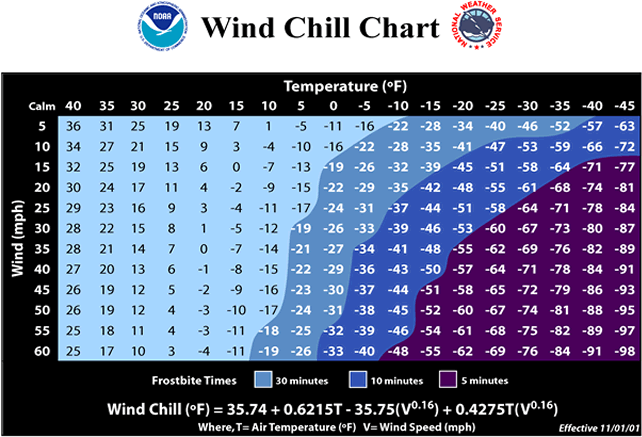
The presence of wind in an already cold environment can pose a deadly combination. It is important to realize the effect wind has when paired with cold temperatures. For example, if it is 10 degrees Fahrenheit outside and there are also 20 MPH winds present, the temperature feels like -9 degrees Fahrenheit to the body. Because of the danger wind poses in cold weather, the National Weather Service will often issue wind chill advisories and warnings when a deadly combination of wind and cold air threaten an area.
[](https://www.safetytalkideas.com/wp-content/uploads/2018/01/Wind-Chill-Chart-Toolbox-Talk.gif)
** Best Practices to Avoid Cold Stress-Related Health Hazards:**
- Eliminate or limit work as much as possible when extremely cold temperatures are present.
- Allow for acclimatization to cold environments or weather. If the weather is extremely cold for the area or time of year, you will not yet be used to it and are more susceptible to succumbing to a cold-related illness.
- Layer up on clothing and keep clothes dry. It is important to remove any wet clothing or boots and put on dry items when working in a cold environment.
- Take breaks in warm areas or vehicles as needed.
- Drink warm beverages to help warm up your core temperature.
- Monitor the condition of other workers around you. If you notice something could be wrong, get them into a warm area and notify a supervisor.
**Summary:**
Cold weather brings additional hazards for workers who are exposed to colder temperatures. Winds can create a dangerous situation in cold weather climates. Follow best practices when working in cold weather environments to lessen the chance of becoming a victim of frostbite, trench foot, or hypothermia.
***By Clicking "Mark as Read" - you are acknowledging you have read this entire (opened appropriate attachments) ToolBox Talk and understand this is company policy and will abide by regulations outlined in this safety policy. Please complete your acknowledgement within 24 hours of release. If you are receiving this notice, you are REQUIRED to read this content.***